


In January 2022 Google announced that the legacy free edition of G Suite would stop being available and that those using it would have to move to a paid Google Workspace subscription. We published this article that month.
The deadline has passed and the story ended a little differently than announced. Here we keep what we explained back then and tell you what finally happened to those accounts and which options your company has today for its business email.
In 30 seconds
- What it was: a free edition of G Suite that Google stopped offering to new customers in December 2012.
- What happened in 2022: Google moved business-use accounts to a paid Google Workspace subscription.
- The exception: people using it for personal, non-commercial purposes were able to keep a no-cost option.
- Today: for a company, email on its own domain is solved with the email included in hosting or with a paid external platform.
The January 2022 announcement
In 2020, G Suite became Google Workspace, as part of the company’s effort to adapt its apps to new working conditions. Several plans were migrated at that time, and in 2022 Google decided to end the legacy free edition of G Suite.
The company communicated it in its help centre: anyone with the legacy free edition had to switch to a paid Google Workspace subscription to keep their services, because that edition would stop being available as of 1 July 2022.
The only free plans that remained in Google Workspace were those for non-profit organisations and for education. Companies that had spent years using Gmail, Drive, Docs and other apps without paying would have to start doing so.
Google Cloud made two clarifications. First, the tools in Google Workspace remained available free of charge for anyone with a Google account. Second, the change did not affect all users: only organisations using the “G Suite free edition” (also called the “legacy free edition of Google Apps”), which gave no-cost access to a reduced set of business features.
Dates and Google Workspace pricing
The dates were given by the company itself. Administrators had until 1 May 2022 to choose a plan. If they did not, Google would pick one based on the features the organisation used, and billing would begin two months after that automatic change.
Anyone who waited had to set up billing before 1 July 2022. Without payment details, the subscription was suspended, and 60 days after the suspension access to the core services, such as Gmail, Calendar and Meet, was lost. Other Google services, such as YouTube and Google Photos, remained available.
Whether it was an organisation or a single person using this free solution born in 2006, they had to confirm which of the four available plans they would move to. Only educational institutions and non-profit entities were spared the payment.
For questions about those legacy accounts, Google opened a questions and answers page about the migration, which is still online and today describes how the process ended.
The April 2022 promotion
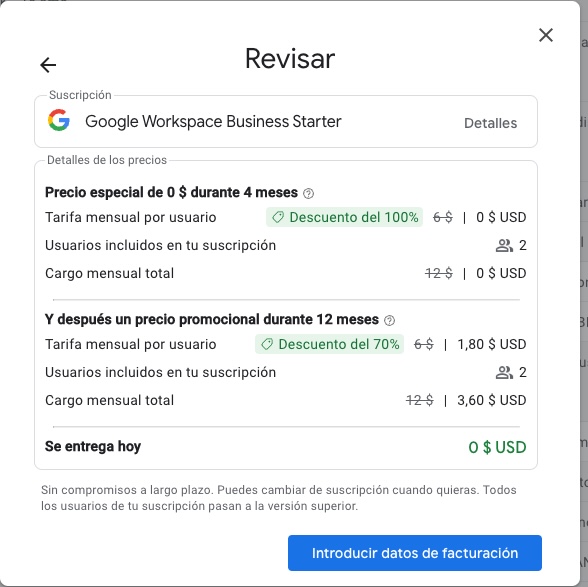
In April 2022 Google offered customers in Colombia who moved off the legacy free version to Google Workspace 4 months of free service followed by 12 months with a 70% discount. That promotion is no longer valid; we keep it as a record of the time.
What happened in the end
The outcome had an important nuance compared with the original announcement:
| Type of account | What happened |
|---|---|
| Business use | Google moved them automatically to a paid Google Workspace subscription. According to its help centre, for businesses the free edition stopped being available after 27 June 2022. |
| Personal or family use, non-commercial | In May 2022 Google enabled a no-cost option for those who declared that use. They keep their domain in Gmail and their data, but without support. |
| Education and non-profit entities | They continued with their specific free editions. |
There is one point worth keeping in mind if your company still uses one of those no-cost accounts: Google states in its transition guide that the free edition is only for personal non-commercial use, that it reviews accounts and that it may suspend those that keep using it for commercial purposes. Business email running on a legacy free account is a risk.
Which options you have today for your company’s email
If your company ended up in that situation, or if you are defining email on your domain for the first time, you have two paths:
| Option | When it makes sense |
|---|---|
| Email included in web hosting | When you need accounts on your domain for day-to-day work and do not want to pay a subscription per user. |
| Paid external platform (Google Workspace, Microsoft 365, Zoho Mail) | When, besides email, you need large storage, video calls, shared documents and centralised administration. |
At Damos, all web hosting plans include the webmail platform, with email accounts on your own domain. As a complementary service, you can also opt for external business email with Google Workspace. Keep in mind that a domain can only use one email platform at a time, so it is best to define it at the start; the hosting plans page has the details.
Does your company still depend on a legacy free account for its email?
Frequently asked questions
Does free G Suite still exist?
Not for businesses: Google moved those accounts to a paid Google Workspace subscription in 2022. Only a no-cost option remains for those who used the legacy edition for personal, non-commercial purposes.
Can I use the legacy free edition for my business?
No. Google states that this edition is only for personal non-commercial use and that it may suspend accounts using it for commercial purposes.
What alternatives are there for email on my domain?
The email included in your web hosting or a paid external platform such as Google Workspace, Microsoft 365 or Zoho Mail. The choice depends on how many users you have and whether you need collaboration tools.
Does Damos hosting include business email?
Yes. All plans include the webmail platform, with email accounts on your own domain. As a complement, you can opt for Google Workspace.
Can I use Google Workspace and hosting email at the same time?
Not on the same domain. A domain can only use one email platform at a time.
Need to define your company’s email?
Tell us how many accounts you need and how you use them. We will tell you which option fits your company best.
Let’s talkKeep reading
Sources: Google Workspace Help, transition off the G Suite legacy free edition and transition guide for free editions. Article published in January 2022 and reviewed in November 2026.



