


When we published this article, in April 2019, Facebook (now Meta) had just started charging the 19% VAT on the ads bought by advertisers in Colombia, and Google was doing the same with its advertising. It was news back then; today it is the rule for any digital service paid to a platform based abroad.
We kept what we explained at the time and added what happened next and what it means today for your company’s ad budget.
In 30 seconds
- Since December 2018, Facebook has charged 19% VAT on ads in Colombia, with effect back to July 1, 2018.
- VAT is added to every charge: if you spend 100 on ads, you pay 119.
- The underlying rule is Law 1819 of 2016, which brought digital services provided by foreign companies into the VAT system.
- If your company is registered as responsible for VAT, this tax follows its own treatment: check it with your accountant.
What Facebook announced in 2018
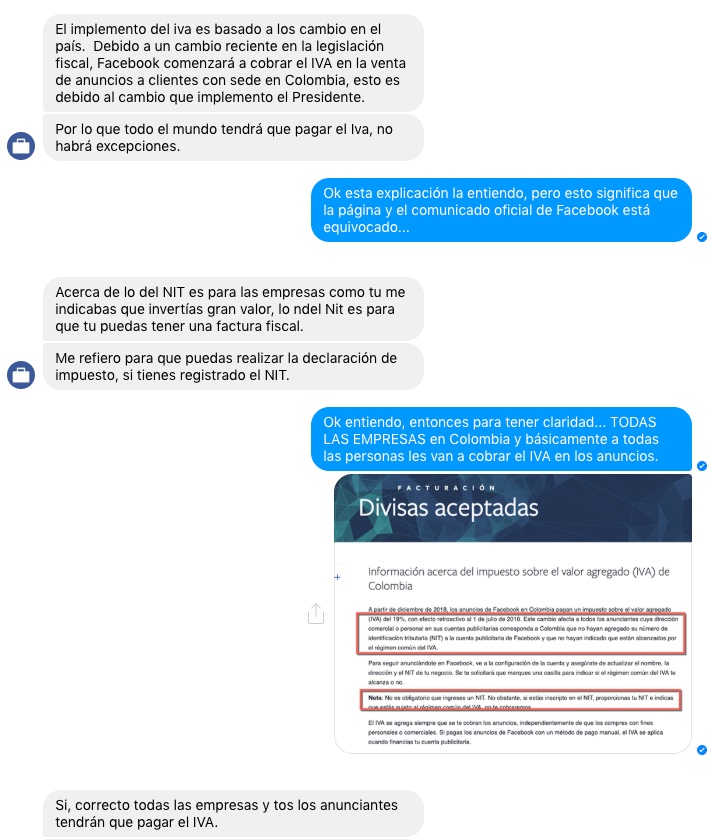
“Starting in December 2018, Facebook ads in Colombia are subject to a 19% value-added tax (VAT), retroactive to July 1, 2018.”
That is how the Facebook help page for advertisers explained it. VAT was added every time ads were charged, whether you bought them for personal or business purposes. If you paid for ads with a manual payment method, VAT was applied when you funded your ad account.
How VAT showed up in the charge
For example, if you were charged $100 because you reached your $100 billing threshold, the subtotal of the charge was $100 in ad costs. The 19% VAT was added on top, so you ended up paying $119 in total ($100 + $19 = $119.00). The VAT charge did not make you reach your billing threshold faster, but you could be charged an amount higher than your threshold.
Did every advertiser pay it?
Facebook’s official notice was unclear and suggested that companies under the common tax regime would not be charged VAT. So, at the time, we asked Facebook support (available only by chat), and they confirmed that every advertiser would pay the 19% VAT.
What happened next
The charge was not temporary. Its basis is Law 1819 of 2016, which included in VAT the digital services that foreign providers sell to users in Colombia, at the general 19% rate. Today Meta, Google and the other ad platforms apply this tax in one way or another.
- Platforms explain it in their help pages. For example, TikTok states that it charges 19% VAT in Colombia unless you provide your business tax ID information.
- Companies responsible for VAT follow a different treatment. According to Alegra’s guide on taxes for advertising on Google Ads and Meta Ads (in Spanish), in that case the company self-assesses the 19% (article 437-2 of the Colombian Tax Code) and can claim it as deductible VAT.
This article is not tax advice. How to report the VAT on your ads depends on your tax regime: confirm it with your accountant.
What it means for your company
If you invest in ads, VAT is part of the real cost of every campaign. That is why, when you set your budget, it helps to separate what goes into ads and what goes into taxes, and to measure results against the total cost.
In our digital marketing service we handle the strategy, the ads on Google Ads and Meta Ads and the measurement of results. If you want to know how to split your investment between platforms, see how we plan campaigns in digital marketing for companies.
Frequently asked questions
Do Meta and Google ads pay VAT in Colombia?
Yes. Digital services that foreign providers sell to users in Colombia carry the 19% VAT since Law 1819 of 2016, and ad platforms apply it to their charges.
How much VAT do you pay on digital ads?
The general 19% rate. If you invest 100 in ads, the total charge is 119.
Can my company deduct that VAT?
If it is responsible for VAT, the tax follows its own treatment (article 437-2 of the Colombian Tax Code) and can be claimed as deductible. Confirm it with your accountant according to your regime.
Want your ad investment to go further?
Let’s talk about your strategy on Google Ads and Meta Ads and how to measure what every peso you invest brings back.
Let’s talkKeep reading
Sources: Facebook Business Help, VAT in Colombia (2018 notice) · Alegra, taxes for advertising on Google Ads and Meta Ads · TikTok Ads, VAT in Colombia · Law 1819 of 2016 and article 437-2 of the Colombian Tax Code. Article published in April 2019 and reviewed in November 2026.